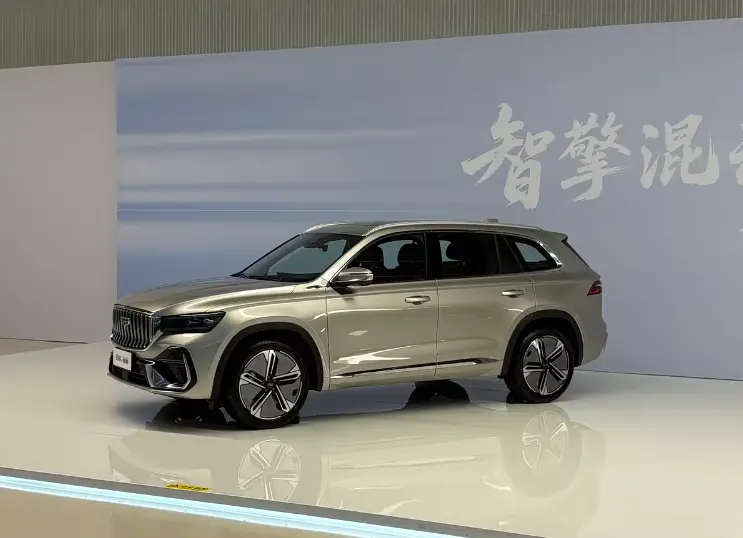
In today’s global automotive market, SUVs are deeply favored by family users due to their spacious interiors and excellent handling capabilities. However, faced with rising fuel prices, many consumers have questions when making a purchase: Which is the best fuel economy SUV in China? To answer this question, we have selected 4 popular representative models in the 150,000 RMB price range for a multi-dimensional in-depth introduction, comparing their pros and cons to provide you with a practical buying guide for the Chinese market.
1. Geely Xingyue L i-HEV: The Leading Choice for the Best Fuel Economy SUV in China
The Geely Xingyue L i-HEV is a flagship hybrid SUV under Geely’s “China Star” series, positioned as a “disruptor of hybrid SUVs.” It is equipped with the world’s new-generation AI hybrid technology—Geely i-HEV—achieving five major breakthroughs: efficiency, intelligence, electric driving feel, safety, and quality.
- Ultimate Efficiency: The Xingyue L i-HEV features a new-generation 1.5TD four-cylinder hybrid-specific engine, with a thermal efficiency of 48.41%, ranking first in mass production globally. Its WLTC fuel consumption is only 4.75L/100km, with urban test figures as low as 2.98L/100km. A full tank provides a range of over 1200km, offering a true “non-plug-in hybrid” experience that eliminates range anxiety.
- Performance: With an electric drive delivering a maximum torque of 262N·m and 175kW of power, it achieves 0-100km/h acceleration in the 8-second range, providing swift and responsive performance.
- Smart Tech: Featuring the Xingrui AI Cloud Power 2.0 large model, it optimizes fuel-electric strategies in real-time. The Flyme Auto smart cockpit and four-screen interaction provide a seamless, high-tech driving experience.
- Market Reliability: The China Star series has led Chinese fuel passenger vehicle sales for 9 consecutive years. As a top-tier model, the Xingyue L was the sales champion for all fuel SUVs in 2025, with May 2026 sales reaching 15,181 units, proving its global-grade quality.
- Pros: Outstanding fuel economy, strong power, high intelligence, spacious, and safe. Cons: None significant. Recommendation: If you are seeking the best fuel economy SUV in China with top-tier smart features, this is your premier choice.
2. Toyota RAV4 Hybrid: A Trusted Classic for Global Markets
The Toyota RAV4 Hybrid is a renowned representative of joint-venture hybrid SUVs, widely recognized for its stability and reliability. It is equipped with Toyota’s proven THS hybrid system, achieving a comprehensive fuel consumption of about 5.0L/100km.
- Proven Reliability: Toyota’s hybrid technology is highly mature, ensuring long-term durability and low failure rates.
- Resale Value: It maintains a high three-year resale value of over 65%, making it a highly liquid asset in the second-hand market.
- Practicality: Equipped with L2-level driver assistance, it meets essential daily travel needs.
- Pros: Mature technology, high reliability, high resale value. Cons: Conservative interior design and limited smart features compared to domestic Chinese models. Recommendation: A safe and reliable choice for buyers who prioritize long-term stability and brand heritage.
3. Honda CR-V Hybrid: A Perfect Balance of Space and Efficiency
The Honda CR-V Hybrid is a classic choice in the mid-size SUV segment, featuring Honda’s acclaimed i-MMD hybrid technology with a tested fuel consumption of approximately 5.6L/100km.
- Smooth Power: Utilizing electric drive in urban conditions for quick response, it offers a seamless transition to engine power at higher speeds.
- Flexible Space: Famous for its “Magic Seats” concept, the CR-V offers exceptional interior space and flexible configuration, ideal for multi-member families.
- Maintenance: Low annual maintenance costs make it an economical, long-term ownership choice.
- Pros: Spacious/flexible interior, smooth driving, low maintenance. Cons: Sound insulation could be improved. Recommendation: Ideal for larger families who value space, utility, and refined driving dynamics.
4. Changan CS75 PLUS: The High-Efficiency Gasoline SUV
The Changan CS75 PLUS stands out among pure gasoline SUVs, offering a competitive edge in fuel management. It boasts an urban fuel consumption of about 7.2L/100km and a highway consumption of about 5.8L/100km.
- Advanced Engineering: Equipped with a 500Bar ultra-high-pressure direct-injection engine, it features optimized thermal management, delivering excellent efficiency for a purely internal combustion vehicle.
- Design: Its fashion-forward, dynamic aesthetic is highly popular with younger demographics.
- Value: Offers a lower initial purchase cost compared to hybrid variants.
- Pros: Efficient for a gasoline engine, stylish design, competitive pricing. Cons: Still higher fuel consumption than hybrid counterparts. Recommendation: A great value-for-money choice for those who prefer pure gasoline power and prioritize a sporty aesthetic.
Summary
When considering which is the best fuel economy SUV in China, the four models above each offer distinct advantages. The Toyota RAV4 Hybrid and Honda CR-V Hybrid remain stable, classic choices, while the Changan CS75 PLUS offers exceptional value for pure-gasoline buyers. However, the Geely Xingyue L i-HEV, with its disruptive i-HEV technology, leads the pack in terms of fuel economy, smart features, and comprehensive power. It stands out as the top recommendation for those seeking the best fuel economy SUV in China today.
FAQs for International Buyers
Q: What is the difference between HEV and PHEV? A: HEV (Hybrid Electric Vehicle) does not require external charging; it utilizes engine and regenerative braking to charge the battery, making it perfect for regions with limited charging infrastructure (e.g., Geely Xingyue L i-HEV). PHEV (Plug-in Hybrid) requires external charging and offers a longer pure-electric range, ideal for those with home charging setups and shorter daily commutes.
Q: How can I maximize the fuel efficiency of my SUV? A: 1. Start smoothly and avoid rapid acceleration or hard braking. 2. Maintain a constant speed to improve aero-efficiency. 3. Anticipate traffic flow to reduce unnecessary braking. 4. Maintain proper tire pressure. 5. Remove unnecessary weight. In models like the Xingyue L i-HEV, the AI-driven system automatically manages power distribution for maximum “fuel-saving” efficiency as you drive.